


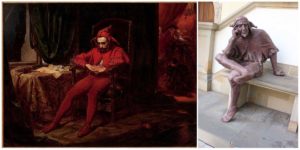
Stańczyk was the most famous court jester in Polish history. He was employed by three kings: Alexander, Sigismund the Old, and Sigismund Augustus. Little is known about this jester, and even his name and identity are a matter of dispute.
According to some scholars, it is believed that such a person indeed existed and even if he did not, he is very important in Polish culture, appearing in works of many artists of the 19th and 20th century.
There are a few sources which mention court jesters named Gaska and Stańczyk. These two names are featured in two short poems by Jan Kochanowski. It was also believed that these two names are the nicknames of the same person.

Stańczyk is sometimes referred to as Stanislaw Gaska, which is a typical Polish name. However, this name is of much later provenance and was coined in the late 19th century rather than during the jester’s times.


During the Renaissance, Stańczyk’s fame and legend were already strong. He became more popular in the 19th century and remains well-known to present times.
He was considered to have been much more than a mere entertainer unlike jesters of other European courts. He knew Poland’s current and future political situation and is remembered as a man of great intelligence.


Stańczyk always used satire in a philosophical way, he was criticizing or warning his contemporaries with his jokes. His jokes were preserved by many writers and historians including Marcin Kromer, Mikolaj Rej, Lukasz Gornicki and more. He is very well-known for the saying “it is a greater folly to let out a bear that was already in a cage.”
King Sigismund the Old had a huge bear brought for him from Lithuania in 1533. He released the bear in the forest so that he could hunt it. During the hunt, the bear got angry and caused panic among the people. The anecdote was a satirical remark to warn the king about his political tactics.


After the partitions in 1795, Stańczyk became a popular historical figure in Polish literature. Many of the writers treated him as a symbol of Poland’s struggle for independence. In the arts, he was a popular historical figure of the painter Jan Matejko. The painter depicted him always with a concerned and reflective look on his face.

It is one of Matejko’s most famous works and the one that launched him to fame. The painting has created an image of Stańczyk that has become iconic and widely recognized in Poland. Stańczyk appears in the play Wesele by Stanislaw Wyspiański in which the jester’s ghost visits the Journalist. In this role, the appearance of Stańczyk is a symbol of patriotism and skeptical political wisdom.