


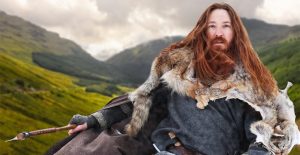
Cú Chulainn is known for transforming into a powerful creature when angry and is long associated with the color green. However he isn’t the Incredible Hulk.
This formidable hero – pronounced “Koo hoo lin” – is a defining figure from Irish mythology, though he’s sometimes compared to Bruce Banner and his struggles with gamma radiation. Cú Chulainn’s battles are recounted in Táin Bó Cúailnge, a first century legend which translates as “The Cattle Raid of Cooley”.
Referred to as “the oldest vernacular tale in western Europe” by the BBC, the hero’s shape-shifting adventures are immortalized in the text. The transformation is “hideous and shapeless, unheard of…His heart boomed loud in his breast like the baying of a watch-dog at its feed or the sound of a lion among bears. Malignant mists and spurts of fire flickered red in the vaporous clouds that rose boiling above his head”.
Like many superheroes, Cú Chulainn came with his own trademark weapon, the “Bellows Spear” (‘Gae Bolga’), a barbed weapon that snags in the body upon impact.

“These sagas contain a wealth of material for the historian,” the BBC writes. “They show us a land where the men were herdsmen, tillers of the soil, hunters, bards, seers, but, above all, warriors.”
But where did it all begin for Cú Chulainn? His origin story is more Grimm’s Fairy Tale than Stan Lee. Originally called Sétanta, he was destined for great things from birth. Not dissimilar to the mighty Thor, his father was rumored to be Lugh the sky god. His mother was Dechtire – her surreal journey into motherhood involved passing out after she swallowed a fly and being approached by Lugh in a dream. Despite tying the knot elsewhere, she turned into a bird and flew away before fluttering back with young Cú Chulainn in tow.

The story gets darker when he was taken under the wing of his uncle, the legendary King Conor of Ulster. Through the King’s negligence, Sétanta turned into the fearsome Hound of Ulster. It happened when Conor was attending a banquet and wanted his nephew to go along. Sétanta arrived late, by which stage the King had forgotten he’d asked him.
The venue had activated its ancient security system, in the form of a huge guard dog. When Sétanta appeared the animal went to attack, but to everyone’s astonishment the lad overcame the hound and fatally subdued it.

Culain, the host of the banquet and a blacksmith, was devastated that his canine protector had died and worried his cattle were now vulnerable. Sétanta told the blacksmith he would carry on where the top dog left off, becoming Cú Chulainn – the hound of Culain – in the process.
The meat of The Cattle Raid of Cooley lies quite literally in a proud brown bull, Donn Cuailnge. This property of the Ulstermen chief was coveted by royal couple Maeve, the Queen of Connacht, and Ailill who owned their own bull but wanted control of Donn Cuailnge and the land. Maeve tried to take her prize in the raid of the title, only to encounter Cúchulainn, by then 17 years old.

When the monstrous warrior proved too hot for her forces to handle, Maeve summoned Fer Díad, Cú Chulainn’s foster brother. A great note of tragedy was struck after Cú Chulainn did away with Fer Díad, and the hero’s fate was soon to follow. Cú Chulainn suffered a gory end at the hands of a vengeful clan.
Calatan the sorcerer had met his end at the hands of Ireland’s champion. His sons and daughters were determined to see young Cú Chulainn fall. They succeeded after he was speared and his head was removed, though not before the hero rallied after salvaging his own intestines!

Yet while he was dead, his legacy endured. Embedded in Irish history, the image of Cú Chulainn and the freedom he represented has been used by various groups for both political and artistic purposes. Nationalists, Unionists and Loyalists have all depicted the half-man, half-dog. But the popular conception of Cú Chulainn can partly be put down to an American President – Theodore Roosevelt.
As described by the Irish Times in 2015, he has “Long hair flowing from under his helmet, spear and shield in hand” and is “the epitome of the valiant Celt.” Roosevelt, together with artist JC Leyendecker, presented Cú Chulainn’s tale afresh in a 1907 article for Century magazine. The effect was powerful, coming after a renewed interest in Celtic history during Victorian times.

Roosevelt’s contribution led to a popularizing of the legend and a generalized approach to Irish and Celtic culture. “Above all else, the diverse manifestations of the Cú Chulainn myth underline not so much its enduring appeal as its cultural malleability,” the Times argues. “In Ireland it underlined a rising nationalism and cultural differentiation… These stirring tales of heroes sacrificing themselves against the odds struck a chord with the wider mood… Cu Chulainn is a mantle of resilience against invaders, depending on who you class as invaders.”
Related Article: The Epic Female Warrior who Trained the Heroes of Irish Mythology
In 1935 a sculpture of Cú Chulainn was unveiled, created by Oliver Sheppard and located at the General Post Office in Dublin. It is the official memorial to 1916’s Easter Rising. More recent interpretations include folk rock albums by the band Horslip and even a Marvel Comics character who battled the Guardians of the Galaxy.
Maybe Cú Chulainn isn’t too far removed from the Incredible Hulk after all…