


It is perhaps not a surprise that someone named Ivan the Terrible was far from a model husband. He was, in fact, a more dangerous spouse than Henry VIII, his near contemporary.
Ivan the Terrible, more formally known as Ivan IV Vasilyevich, was the first ruler to be crowned as “Tsar of All the Russias.” He kept the title until his death in 1584, and all his successors used the same title after him.
Although Ivan the Terrible is known as the Tsar who expanded the territory of Russia, transforming it from a medieval state into a powerful empire, it was always at the cost of his people.
Many people were tortured and killed under his reign. Even his son and heir Ivan Ivanovich wasn’t spared the brutality of the Tsar’s madness. According to historians, Ivan was a complex personality: devout and intelligent but with frequent outbreaks of mental instability. It was probably during one of these outbreaks that he killed his son. Ivan was very paranoid for most of his life.

He was married eight times. All his wives but two died before him or were sent to a monastery.

Ivan was crowned in 1547 when he was only 16 years old, marrying his first wife, Anastasia Romanovna, two weeks later. She gave birth to six children, of whom four died in infancy, leaving Ivan and Feodor as heirs to the throne. Feodor would later become Tsar Feodor I of Russia.

In the summer of 1560, Anastasia fell very ill. Despite having all the best doctors brought to cure her, her health showed no sign of improving and, as her health deteriorated, Ivan’s paranoia grew, believing that somehow his wife had been poisoned in an attempt to poison him. Convinced of a plot, the Tsar ordered the torture and execution of many people, especially the Boyars toward whom Ivan felt exceptional hatred. Anastasia died at the end of that summer. According to Russian folk tales, before dying, she warned Ivan not to marry a pagan wife.
Just a year later, the Tsar married his second wife, Maria Temryukovna, Tsaritsa of the Circassians, a Northwest Caucasian ethnic group. At the time, Christianity hadn’t spread among the Circassians, so Ivan, in fact, married a pagan woman despite Anastasia’s warnings. She was presented to Ivan right after the death of his wife, and the Tsar decided to marry her immediately, apparently unable to resist Maria’s beauty.

Maria was disliked by her subjects, and people feared her, claiming she was witch-like in her behavior. She was considered malicious and manipulative. Probably illiterate, she had a hard time integrating into the Muscovite style of living and didn’t take to her role as a stepmother of Ivan and Feodor. She gave birth to Ivan’s son, Vasili, but the baby died after a few months.
Following eight years of marriage, in 1569, Maria died at the age of 25 in what many believe was a poisoning. The Tsar never confirmed the rumors that it was he who poisoned her. Instead, many people were tortured under the suspicion that they had killed Maria.
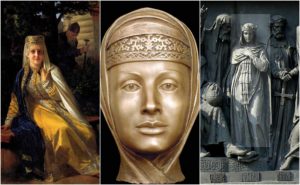
Ivan married his third wife, Marfa Vasilevna Sobakina, daughter of Vasiliy Sobakin, a merchant from Novgorod, in 1571. Ivan selected her from among the 12 finalists to marry the Tsar after a two-year-long search for a wife. She didn’t remain as a Tsaritsa for too long. Even though she was kept in a fortress surrounded by only loyal subjects, Marfa died of poisoning only a few days after the wedding, when she was 19. Her death provoked an extended episode of paranoia in Ivan.

According to the laws of the Russian Orthodox Church, a fourth marriage is forbidden and impious. However, Ivan used the excuse that he didn’t consummate his marriage to Marfa. Even so, when he married a fourth wife, Anna Alexeievna Koltovskaya, in 1572, he did so without the blessings of the church. He grew impatient with her due to her infertility and sent her to live in a convent, where she would go on to outlive the Tsar.

Very little is known about Ivan’s fifth wife, Anna Vasilchikova, except that he married her in 1575, and that by 1576 she was already taking the vows of a nun in a monastery. It is supposed that she died soon after, in 1576 or 1577.

In 1579, Ivan married his most famous wife, Vasilisa Melentyeva, the widow of Prince Melentiy Ivanov. She wasn’t famous because she broke the “spell” of the Tsar’s bad luck with marriages but rather because she made things worse. It was only a few months after she became Tsaritsa that Ivan found out about Vasilisa’s affair with Prince Devletev. Her punishment was to live in a convent but not before she had to witness Devletev’s execution by impalement. She died of unknown causes a few months later.
There is not much-confirmed information about Vasilisa Melentyeva, and many modern scholars believe that she may have been a fictitious wife of the Tsar or just one of his concubines.
In 1573, Ivan married his seventh wife, Maria Dolgorukaya. He might have chosen her because of Maria’s royal bloodline–she was a distant descendant of one of Moscow’s founders, Prince Yuri of Kiev. Once again, Ivan discovered that his wife had a lover. Only this time the Tsar didn’t bother to send her to a monastery. He had her drowned.

In 1581, when he was 51, Ivan married his eighth and last wife, Maria Nagaya. She gave birth to the Tsar’s son, Dimitry. After the death of Ivan in 1584, his wife and Dimitry were sent into exile. Seven years later, Dimitry died under peculiar circumstances, while Maria was accused of negligence and sent to a monastery. To be freed, she was supposed to recognize a False Dimitry as her son, an impostor who took over the throne. She did so and returned to Moscow. However, after the imposter was killed in less than a year, she renounced him. Maria lived until 1608.
“Tsaritsa Marfa exposes the False Dmitry”Each of his wives was beautiful, but, according to historians, Ivan’s love always remained with his first wife. It was Anastasia’s death that triggered his worsening paranoia. The Tsar certainly didn’t do well with family life. He never got over killing his son Ivan, whom he fatally struck in an argument over whether the clothing of Ivan’s wife was too immodest.