


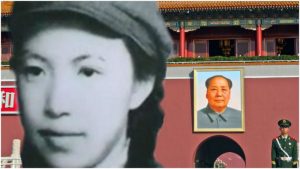
Peng Lingzhao was born to a prominent family in the Jiangsu province in China. Already at the age of 16, she started to write her first articles with which she criticized the corruption of the Nationalist government, using her pen name, Lin Zhao. Aged only 36, Lin was executed for her criticism towards Mao Zedong’s policies and ideology.
Though courageous, Lin’s life story and the way it ended was undoubtedly a tragic one. To date, Zhao remains one of the most prominent dissident figures during the Cultural Revolution of the previous century in China.

Lin’s name became known after she enrolled to study at the Chinese Literature department of Peking University. It was during her university days when she emerged as an outspoken dissident, during the time that the Hundred Flowers Movement of 1957 was also sprouting in the country.
The movement was initiated in 1956 by the Communist Party of China, and it was a hoax that encouraged citizens to openly express their opinions on the communist regime. The Communist Party Chairman, Mao Zedong, had encouraged this movement by stating: “The policy of letting a hundred flowers bloom and a hundred schools of thought contend is designed to promote the flourishing of the arts and the progress of science”.
It was only for a brief period of time that the movement mirrored some sort of liberalization in China when Mao abruptly decided to change the course of action. Consequently, many people who had been encouraged to speak up against the ideology or freely express what they thought about their country were virtually doomed.

Lin was no exception. As part of her punishment, she was ordered to perform menial tasks for her university and some of those tasks were rather bizarre in nature – like killing mosquitoes as part of the Four Pests Campaign. The Four Pests Campaign was one of the first controversial actions taken within the Great Leap Forward in China, following the Hundred Flowers Movement, from 1958 to 1962. The pests that were victims of this action were rats, flies, mosquitoes and sparrows. Unfortunately, the systematic extermination of sparrows led to an ecological imbalance within the country, enabling crop-eating insects to flourish, and causing famine for many families.
Aside from Lin being forced to participate in this type of action, she also had to catalog old newspapers for the reference library at the journalism department of Peking University.

The punishments of the kind that Lin suffered were only part of the general actions affecting each segment of Chinese society. For instance, during the period of Mao Zedong, as part of the Cultural Revolution of the country, even the street names and landmarks were renamed; Andingment Inner Street became “Great Leap Forward Road”; Taijichang Street was changed to the “Road to Eternal Revolution”; and Jingshan Park was changed to “Red Guard Park”. After the revolution, most of the sites were reversed to their previous designations.
Zhao was arrested in 1960, as she was caught helping a group of other dissidents who intended to publish an underground magazine that demoted the Communist Party. This was an attempt by the dissidents to react to the devastation that was caused to the Chinese people by its government through the ironically named Great Leap Forward.
Lin was to be sentenced to 20 years imprisonment. As a political prisoner, she was continually beaten and tortured.

But even in prison, Lin continued to find ways to ensure her dissident spirit be kept alive. She managed to continue writing hundreds of pages of critical commentary about Mao Zedong. She used hairpins and bamboo slivers with her own blood as ink to write down the material. Then a report, dated December 5, 1966, recommended that Lin should be executed. This came after she was found ‘guilty’ of a number of “serious crimes”, which included “insanely attacking, cursing and slandering the great Chinese Communist Party and its leader Mao”.

She was also charged with being guilty of spreading hostility and hatred and publicly shouting reactionary slogans, and for disrupting prison order by suggesting other prisoners rebel. That was of course just a small portion of the full list of charges.
Lin was executed by gunshot in 1968. The scariest and even most bizarre part of the whole story is that Lin’s parents were only made aware of the death of their daughter when a Communist Party official approached her mother to collect a five-cent fee for the bullet used to kill her.